
New Delhi, [5th June 2026] — With the NIRF 2026 rankings due in coming weeks, accreditation and ranking intelligence firm Edhitch (https://www.edhitch.com/) has launched a diagnostic framework for Indian higher education institutions, built on a seven-year longitudinal analysis of NIRF submissions covering all 13 ranking disciplines and 5,076 institutional records.
The framework — comprising parameter-level analyzers for each NIRF scoring category and a separate diagnostic application for NAAC’s binary accreditation regime — is designed to address a pattern the Edhitch Research Team has observed consistently across the dataset: sustained institutional effort that does not translate into proportional movement in rank, grade or learning-quality outcomes.
What the data reveals
Based on multi-year analysis of institutional disclosures and NIRF submissions, Edhitch has observed four issues that recur consistently across institutions:
- Faculty eligibility classification gaps that can suppress Teaching, Learning and Resources scores by several points — often the difference between two rank bands.
- Student strength reporting inconsistencies that materially affect category scores, particularly in the Graduation Outcomes category.
- Research output attribution gaps that reduce the institution’s actual measured impact in the Research and Professional Practice category.
- Limited institutional clarity on the underlying scoring logic of each framework, leading to misallocated effort during submission cycles.
The result is a familiar pattern in Indian higher education: institutions invest substantial time and personnel into accreditation and ranking submissions, but the outcomes do not move year after year. Edhitch’s diagnostic framework is designed to surface where, specifically, that effort is being misdirected — and what existing institutional capacity could be reorganised to close the gap.
The 68% overlap
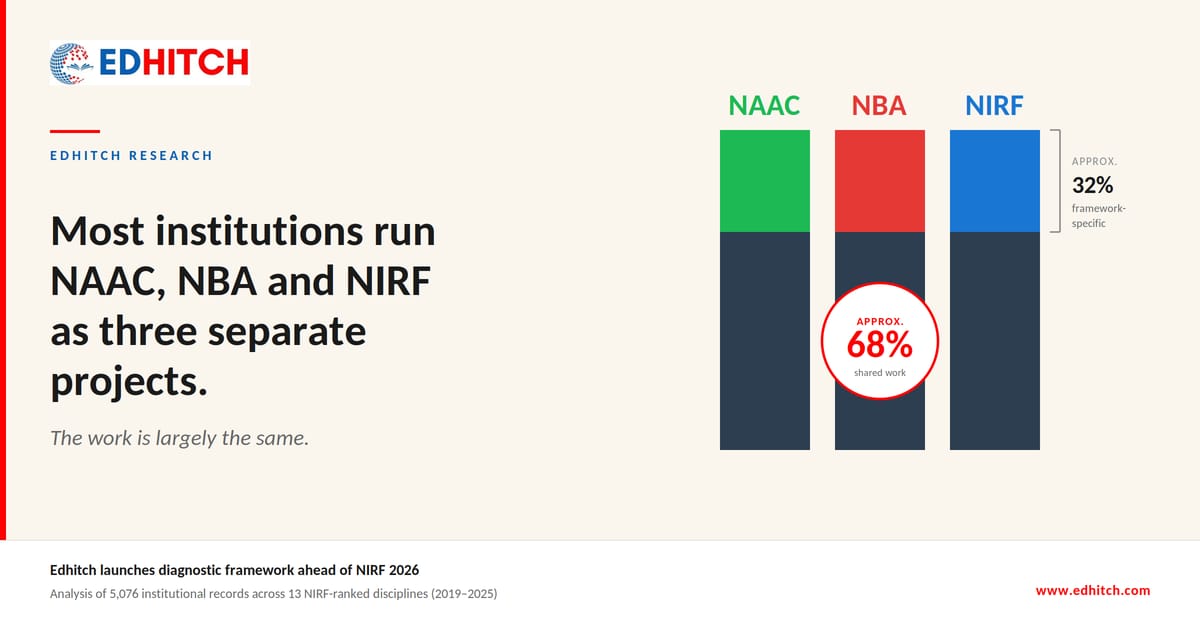
Among the most distinctive findings from Edhitch’s parameter-by-parameter mapping of the three frameworks — covering NAAC’s Self-Study Report (SSR), NBA’s Self-Assessment Report (SAR), and NIRF’s Data Capture System (DCS) — is that nearly 68% of the underlying data, evidence and process work across NAAC, NBA and NIRF overlaps. The implication is direct: most institutions are running the same project three times in silos, when a unified, data-driven approach could significantly reduce effort, cost and internal disruption.
This finding sits at the heart of what Edhitch calls the 12 Theories of Institutional Performance — a proprietary framework that organises recurring institutional performance gaps into operational, structural and strategic categories, distilled from years of working with accreditation submissions, ranking data and institutional self-studies. The framework is treated by the firm as core intellectual property.
A diagnostic-first approach
Unlike conventional accreditation tools that focus on data collection and document compilation, the Edhitch diagnostic framework is designed to identify where institutions currently stand at the parameter level, surface the root causes behind specific performance gaps rather than the symptoms, and produce a resource optimisation plan that prioritises existing capacity over new investment.
A typical Edhitch diagnostic engagement runs over approximately four weeks of in-depth institutional analysis. The duration is intentional: reading an institution’s data deeply enough to identify where its real problems originate — and how its current resources can be reorganised to solve them — is work that does not compress into a one-week audit.
Each engagement is structured to produce three concrete outcomes: gap identification across the relevant accreditation and ranking parameters; a strategy roadmap aligned to measurable framework outcomes; and a resource optimisation plan.
Why Edhitch built its own engines
After working closely with institutions across India, the Edhitch Research Team developed its own diagnostic engines on the finding that existing tools in the market focus only on data collection, fail to integrate strategy with analytics, and cannot identify root causes. The engines are calibrated for discipline-specific contexts including medical, management and engineering institutions, and are built on what few firms in the sector have invested in: a seven-year longitudinal dataset of NIRF submissions with parameter-level granularity across NIRF’s five scoring categories — Teaching, Learning and Resources; Research and Professional Practice; Graduation Outcomes; Outreach and Inclusivity; and Perception.
The reactive trap
Even with a clear case for continuous, data-driven institutional strategy, a familiar pattern persists across Indian higher education: senior leadership tends to frame the work in calendar terms — NIRF is done for this cycle, NAAC is not yet open, NBA is still some time away.
This reactive posture quietly caps an institution’s improvement potential. NIRF momentum for the next cycle is built in the weeks immediately after the previous submission — when the data is fresh and the gaps are visible — not in the rushed window before the next deadline. NAAC strength is shaped by year-round leadership decisions on faculty, research and student outcomes, not by a documentation sprint timed to the submission portal. NBA outcomes reflect curriculum and assessment choices made several cycles in advance.
The institutions that compound rank, grade and learning-quality gains year after year, the Edhitch Strategy Team argues, are those that treat accreditation and ranking as a continuous institutional capability rather than a periodic compliance event.
Looking ahead
As NAAC’s shift to binary accreditation, NBA’s outcome-based regime and the NIRF 2026 cycle in June together raise the bar on what institutions are expected to demonstrate, the shift from compliance-driven processes to data-driven decision-making may well define the next phase of higher education quality enhancement in India.
About Edhitch
Edhitch (https://www.edhitch.com/) is the accreditation, ranking and institutional strategy advisory practice of Adapedu Online Technologies Pvt Ltd. The firm works with Indian higher education institutions across the NAAC, NBA and NIRF frameworks through a four-stage engagement model — workshops, diagnostics, advisory and annual retainers. Its work is anchored in a proprietary seven-year NIRF dataset spanning 5,076 institutional records, parameter-level diagnostic engines, and the 12 Theories of Institutional Performance framework.
Media Contact
Dr Shalini Sharma
Director, Operations
Edhitch
Email: info@edhitch.com
Phone: 9205119385
Website: https://www.edhitch.com/
